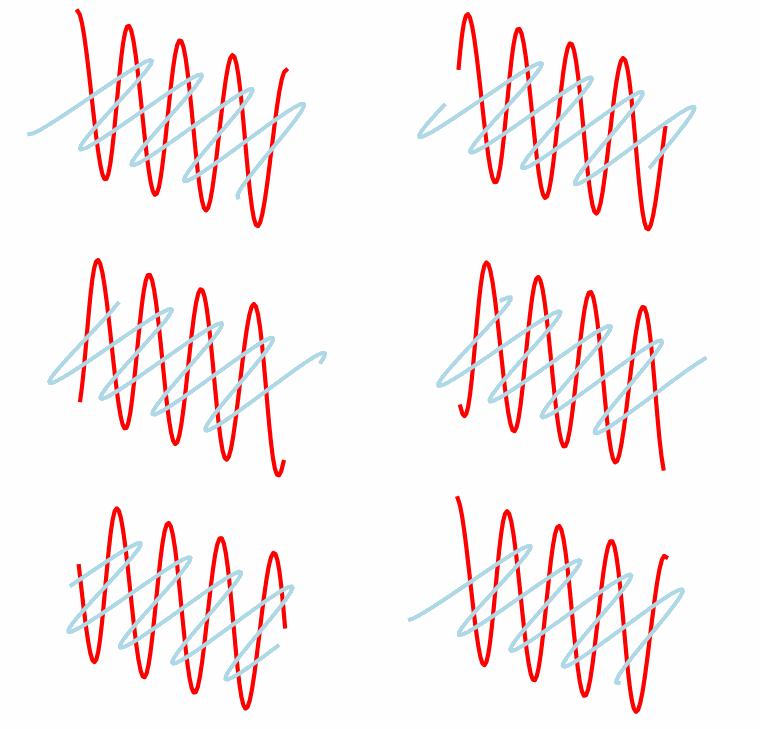
Experimental setups frequently use electromagnetic fields produced by lasers with control over wavelength and polarization. Such fields are purely solenoidal and perpendicular to the direction of propagation. We will here consider the case of a monochromatic light source and two common states of polarization namely linear and circular.
where k=keZ is the wave vector pointing along the direction of propagation. The associated magnetic field is perpendicular to the electric field and given by
We note that the magnetic field strength is equal to that of that electric field divided by the speed of light. In atomic units with c=137.036 a.u., the magnetic field is thus two orders of magnitude smaller than the electric field and depending on the spectroscopy at hand, it can often be ignored in calculations of induced dipole moments.
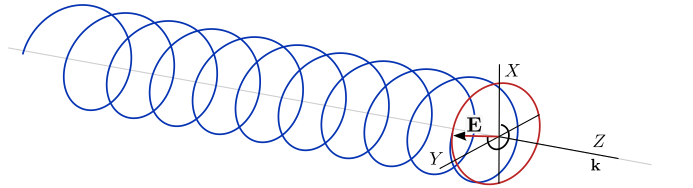
The electric and magnetic field vectors are traced in this illustration by the red and blue curves, respectively.
In this time frozen spatial view, this electric field forms a left-handed helix and we refer to this state of polarization as left circularly polarized light. If we instead time trace the electric field vector at a fixed point in space, say Z=0, it is seen to circle in an anti-clockwise direction when viewed in the direction of the source.
The intensity depends not only on the laser at hand but also on the experimental setup. In a test bed for optical power limiting materials that depend critically on nonlinear absorption, a laser that delivered 1 mJ pulses of 10 ns duration was used. These pulses were focused to a spot size (or circle radius) of 100 μm. The associated intensity becomes
Combining these two equation, we are able to determine the electric field strength for this experimental setup that is designed for the characterization of molecular materials without causing (too frequent) damage. Still, on the atomic scale, this electric field is weak and in the order of 10-5 a.u., which very much is the foundation for our approach of identifying molecular properties from perturbational field expansions of induced moments.
When studying physical processes involving light–matter interactions, experiments are predominantly performed in the liquid phase. To connect theory to such experiments, it becomes necessary to take into account the random molecular orientation.
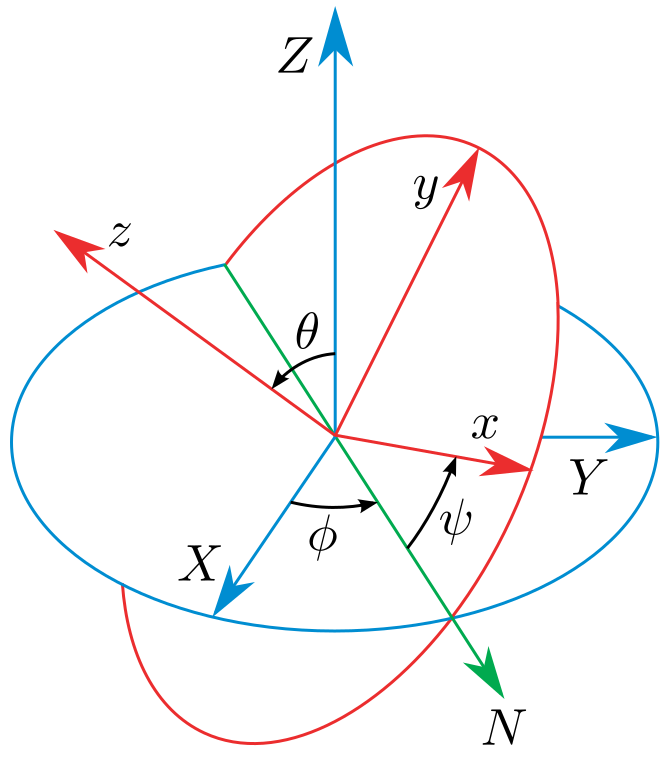
Let us consider a laboratory frame that is space fixed with Cartesian axes X, Y, and Z and an arbitrarily oriented molecular frame with Cartesian axes x, y, and z. It is a common practice to relate these two frames of reference by means of a non-unique set of three Euler angles. We choose the elementary rotations to be intrinsic and referring to the axes sequence (z-x-z). The associated proper Euler angles are denoted by ϕ, θ, and ψ and they are illustrated in the figure below.
The three unit vectors in the molecular frame relate to those in the laboratory frame according to
where the Einstein summation convention has been adopted for the repeated index λ. The expression for the transformation of higher-order property tensors follow suit
In general, an expression for an observable T takes the form
T=Ai1⋯inPi1⋯in
where the tensor Pi1⋯in contains the response of a molecule subject to external fields under conditions represented by the tensor Ai1⋯in. The tensor components are given in the space-fixed laboratory frame, typically with an orientation chosen such that the polarization information can be straightforwardly expressed in Ai1⋯in.
For a randomly oriented molecular system, the a calculation of the observable requires the calculation of rotationally averaged products of the aforementioned direction cosines
Since integrals of first order Ii;λ are zero, the rotational averages of first-rank tensors (such as the dipole moment) vanish.
Induced moments, on the other hand, involve higher-order tensors that do not necessarily vanish upon rotational averaging. As an example, to linear order, the induced dipole moment in an electric field equals the product of the polarizability and the electric field, here assumed to be applied along the Z-axis in the laboratory frame,
In the perturbative expansion of the electric dipole polarization - the expectation value of the induced electric dipole operator where nonvanishing permanent dipole is subtracted - one often encounters situations where the general expression of the molecular contribution to a particular term of the expansion takes the form
Above Δ(ω1,ω2,⋯,+ωn,ωσ,ωop) is a general function involving ωop - the collection of transition frequencies between states o and p, ω1,⋯,ωn - the angular frequencies of the radiation, and ωσ=ω1+⋯+ωn. Summations run over all states of the molecule. Furthermore, A,B,⋯,M are operators such as μ^ or m^, yielding transition moments in the molecular frame, whereas R is a scalar or - see above - a unit vector while S,⋯,Z represent field quantities aligned with the laboratory frame. Usually the terms within brackets in the numerator are elements of the multipolar expansion of the hamiltonian describing the interaction of the molecule with the electromagnetic interaction, for example
When the perturbation includes electromagnetic field gradients (i.e. tensorial physical quantities of rank two or more, as for instance terms like (q^:∇E), the scalar product turns into general tensor contractions, f.ex.
ultimately involving combinations of unit vector representing the cartesian directions of the laboratory frame. Note that for sake of symplicity we use the traced form of the quadrupole q in place of the more popolar traceless form Θ throughout the rest of these notes, and that the second → (in place of the equal sign) above highlights the existence of a an electron charge factor implied at the denominator.
As a specific example of what we are going to discuss in this section, let’s concentrate on the perturbative expansion of the electric dipole polarization, a vector, in particular on the all electric dipole second order contribution μ(ωσ,t) describing the sum frequency generation process when two beams propagating in the same direction and of angular frequency ω1 and ω2 impinge into a molecular system. The structure of one of the six terms entering in the general case of different optical angular frequencies this contribution is
The other five terms are obtained by permuting optical frequencies ω1,ω2,ωσ. For our further discussion, only the numerators of the above equation are essential. Following the example of sum frequency generation, we concentrate on the numerator
The vectors representing field quantities are usually reduced to the product of a scalar field strength times linear (in general complex) combinations of the unit cartesian vectors defining the laboratory frame, see definitions given in the previous section. Indeed, the matrix elements of the electric dipole operator are fixed on the molecule whereas the radiation field vectors are defined in the frame of the laboratory. If the molecule is rigidly oriented with respect to the laboratory, we can choose to align its axes along the laboratory frame. Without loss of generality, in the particular case of linearly polarized fields propagating along the Z direction, we can then align the first field along the X direction, and the second on the X,Y plane. For this example, let’s choose as direction of polarization for the second field directly the Y axis. Then Eω1=EXω1eX and Eω2=EYω2eY, where the dependence on time and angular frequency is in the scalar field strengths EXω1 and EYω2. The contribution to the polarization vector along the Z-direction (i.e. q=Z above), restricting our focus on the numerator will then be of the form
Under rotation this product transforms as a tensor with a rank equal to the number of dots enclosed within parentheses (left) or components (right). Therefore if n=3 in the last equation, the product transforms as a tensor of rank three. If we swap f.ex. (B⋅ei2)→(q:ei2ei3), or equally Bi2→Bi2i3 then the product transforms as a tensor of rank four. The rotational averaging of such higher-rank Cartesian tensors has been treated in the literature by several authors, see e.g. Barron (2004)Friese et al. (2014). We follow here the approach taken by Wagnière Wagniére (1982)Wagniére (1982). We indicate the isotropic average of the sequence Ai1Bi2⋯Min over the solid angle Ω as ⟨Ai1Bi2⋯Min⟩Ω.
For sum frequency generation, performing the necessary integrals involving directional cosines introduced above one gets easily to the following expression
yielding for the averaged second order contribution to the electric dipole polarization describing a generic sum frequency generation process the expression
We first notice that the averaging process decouples molecule fixed vectors/tensors from laboratory-fixed field quantities. Furthermore, the vector products determining the molecular response χav(−ωσ;ω2,ω1) yield a nonvanishing pseudoscalar only for systems belonging to point groups where a center of inversion (or more rigorously an improper axis of rotation) is included in the symmetry group generator, e.g. in molecules exhibiting chirality. Equally important is the fact that the same pseudoscalar vanishes in all isotropic fluid media when ω1=ω2 (optical second harmonic generation) and where it is nonvanishing, the corresponding induced polarization can in principle be detected only along the direction perpendicular to the plane containing the polarization directions of the two electric fields Eω1 and Eω2, directions that cannot coincide. All other contributions vanish. Thus the optical sum frequency generation response (due to the interaction of the molecules solely with the optical electric fields composing the impinging radiation) can be seen only in chiral fluid, with an experimental setup with crossed optical electric fields of different angular frequency and aligning the detector along the direction perpendicular to the plane defined by the polarization vectors (transversal). Below we will extend the analysis to the effects of quadrupolar (electric field gradients) interactions.
Formulas for tensor properties of rank two to five
The procedure to obtain general formulae for rotational averages of tensors of any order is a straightforward, albeit increasingly mathematically intense as the order rises, generalization of that discussed above. The resulting compact expressions for tensors of rank from two to five are
In the section above, the second equation (rank three) is a generalization of the results obtained in the application of the averaging process to the case of sum frequency generation. Let’s use the first equation, involving rank two tensors, and apply it to the case of the electric dipole polarizability α(−ω;ω), when A=μik, B=μki,
appear. The operator ∇ implies a differentiation applying only to the Eω2 field vector(s) eventually appearing on the right. This is an important remark since in the process of the isotropic averaging the ∇ vector operator behaves as any other space-fixed vectors in the application of the rules given above for tensors of ranks from two to five and it moves in principle around in the corresponding expression. In our specific case, since the transformation is here that of a rank three tensor, we apply the same procedure seen above for sum frequency generation and write
The last equal sign stems directly from the structure of the (μil⋅[μ×μ]li) product. The same applies to the contribution obtained permuting the two operator with associated angular frequencies.
Finally, let’s work out the expression of the spatially isotropically averaged contribution to the circularly difference effect in an optically active system for sum frequency generation due to the quadrupolar interaction. For instance, we concentrate on the term (one of the six arising from the permutation of operators and associated frequencies, and we assume this as understood when we write ⟨μil(qlk:∇Eω1)(μki⋅Eω2)⟩Ω=…)
Note that the vectors (rank one tensors) μ arising from the (rank two) tensor q both carry the indices lk and must be reassociated after the application of the averaging. In short, f.ex., a μlk⋅μlk turns into
where we have used the fact that the differentiation applies only to the Eω1 field and it moves further to the right when it is in front of Eω2.
Let’s the concentrate on the molecular response conterpart (i.e. the arrangement of the A, B, C and D terms). From both the first and second row of the rank four formula given above the quantity associated to the sum of the ∇(Eω1⋅Eω2) and (Eω2⋅∇)Eω1 field factors is seen to be
Once again, this is only one of the terms coming from permutations of operators and associated angular frequencies. Moreover, the process has contributions also for the term where the quadrupolar contribution is associated to the angular frequency ω2. Note in the last expression that the contribution coming from the field factor Eω2(∇⋅Eω1)
vanishes due to the presence of the divergence of the electric field Eω1. The expression holds for all arrangement of the fields and for every choice of polarization, and again it yields an immediate information of how fields (mutual direction of propagation, choice of the circular frequencies and of their polarization) should be arranged in the experiment to allow detection of a given high order optical effect in freely rotating assemblies of absorbers.
Barron, L. D. (2004). Molecular Light Scattering and Optical Activity. Cambridge University Press. 10.1017/CBO9780511535468
Friese, D., Beerepoot, M., & Ruud, K. (2014). Rotational averaging of multiphoton absorption cross sections. J. Chem. Phys., 141, 204103. 10.1063/1.4901563
Wagniére, G. (1982). Optical Activity of higher order in a medium of randomly oriented molecules. J. Chem. Phys., 77, 2786. 10.1063/1.444166
Wagniére, G. (1982). The evaluation of three-dimensional rotational averages. J. Chem. Phys., 76, 473. 10.1063/1.442747