Since the Hartree–Fock state in many cases approximates the exact electronic ground state wave function quite well, it is natural to use perturbation theory as a means to improve the description. The starting point it to divide the Hamiltonian into two parts
where is some zeroth-order Hamiltonian and is the perturbation. The orthonormal eigenstates of are assumed to be known
The exact ground state is a solution to the time-independent Schrödinger equation
where and are expanded in orders of
Such an order-by-order procedure may converge given that includes the main features of , and that in some sense is significantly smaller than . We get
Collecting terms to order gives us the master equation of Rayleigh–Schrödinger pertubation theory (RSPT)
Solving the RSPT master equation
To zeroth order, we get
resulting in
We note that the component of in higher-order corrections becomes undetermined since
We will choose such that for . This corresponds to a choice of intermediate normalization
With this choice made, the energy corrections are easily obtained from the RSPT master equation by a projection with :
Wave function corrections are obtained from the RSPT master equation by multiplying with the inverse and projecting out the zeroth-order solution in accordance with choice of intermediate normalization
where
Numerical illustration
Let us set up a ten-states model of a system. This setup includes defining a diagonal zeroth-order Hamiltonian matrix, , and a comparatively smaller perturbation matrix, , without coupling between the ground and first excited state. The state energy separation in the unperturbed system is customizable.
import numpy as np

np.set_printoptions(precision=4, suppress=True, linewidth=132)


def setup_system(energy_separation=0.5, verbose=False, n=10):

    E_0 = 1.5
    Phi_0 = np.zeros(n)
    Phi_0[0] = 1

    H_0_diag = np.arange(E_0, E_0 + energy_separation * n, energy_separation)
    H_0 = np.diag(H_0_diag)

    np.random.seed(20220526)
    V = -0.1 * np.diag(np.random.rand(n) * 0.1)
    for i in range(2, n):
        V[i - 2 : i, i] = np.random.rand(2) * 0.25
    V = V + V.T

    H = H_0 + V

    eigval, _ = np.linalg.eigh(H)
    E_exact = eigval.min()

    # M = P * (H_0 - E_0)^{-1} * P
    M_diag = H_0_diag - E_0
    M_diag[0] = 1
    M = np.diag(1 / M_diag)
    M[0, 0] = 0

    E = [E_0]
    Psi = [Phi_0]

    if verbose:
        print(H)

    return E_exact, E, Psi, V, M
For a given system, the RSPT equations are solved to determine the energy up to a given order. In a first example, we consider a system where the separation energy is 0.50 and equals twice the maximum perturbation energy of 0.25.
E_exact, E, Psi, V, M = setup_system(energy_separation=0.5, verbose=True, n=10)[[1.4931 0. 0.1577 0. 0. 0. 0. 0. 0. 0. ]
[0. 1.9948 0.2499 0.0431 0. 0. 0. 0. 0. 0. ]
[0.1577 0.2499 2.4836 0.1796 0.2426 0. 0. 0. 0. 0. ]
[0. 0.0431 0.1796 2.9848 0.1341 0.2125 0. 0. 0. 0. ]
[0. 0. 0.2426 0.1341 3.4843 0.2393 0.0742 0. 0. 0. ]
[0. 0. 0. 0.2125 0.2393 3.9982 0.1831 0.0795 0. 0. ]
[0. 0. 0. 0. 0.0742 0.1831 4.492 0.2116 0.2425 0. ]
[0. 0. 0. 0. 0. 0.0795 0.2116 4.9965 0.1532 0.0945]
[0. 0. 0. 0. 0. 0. 0.2425 0.1532 5.4865 0.2328]
[0. 0. 0. 0. 0. 0. 0. 0.0945 0.2328 5.9925]]
def rspt_solver(E_exact, E, Psi, V, M, verbose=False):

    error = [E[0] - E_exact]

    if verbose:
        print(" n   RSPT energy    Error")
        print(f" 0 {E[0]:12.8f} {error[0]:14.8f}")

    for m in range(1, 10):

        E.append(np.einsum("i,ij,j", Psi[0], V, Psi[m - 1]))
        error.append(np.array(E).sum() - E_exact)

        R = np.einsum("ij,j->i", V, Psi[m - 1])
        for k in range(1, m):
            R -= E[k] * Psi[m - k]

        Psi.append(np.einsum("ij,j->i", -M, R))

        if verbose:
            print(f"{m:2} {np.array(E).sum():12.8f} {error[-1]:14.8f}")

    return E, error
_ = rspt_solver(E_exact, E, Psi, V, M, True) n RSPT energy Error
0 1.50000000 0.03590812
1 1.49306122 0.02896934
2 1.46820039 0.00410850
3 1.46796433 0.00387245
4 1.46420937 0.00011749
5 1.46437373 0.00028185
6 1.46401910 -0.00007279
7 1.46407353 -0.00001836
8 1.46407816 -0.00001372
9 1.46408390 -0.00000798
Convergence of the ground state energy is reasonably smooth with significant increases in accuracy occurring at even orders in perturbation theory.
In a next illustration, we will study how the convergence depends on the state energy separation.
import matplotlib.pyplot as plt

for energy_separation in [0.18, 0.25, 0.3, 0.5, 1.0]:

    E_exact, E, Psi, V, M = setup_system(energy_separation, False, 10)
    E, error = rspt_solver(E_exact, E, Psi, V, M, False)

    plt.plot(range(10), error, label=f"Separation = {energy_separation:.2}")

plt.legend()
plt.setp(plt.gca(), xlim=(0, 9), xticks=range(10))

plt.ylabel("Energy error")
plt.xlabel("RSPT order")

plt.show()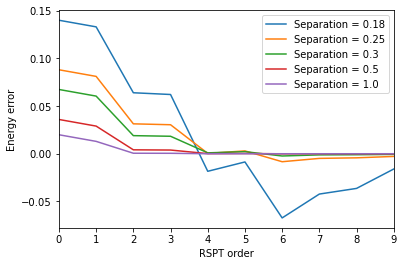
As clearly seen, the convergence rate and even success depends critically on the state energy separation. This is due to the fact the a smaller energy separation leads to larger inverse matrix in the RSPT equation from which we determine the state vector correction .
Size extensivity in RSPT
A system composed of two noninteracting subsystems has a Hamiltonian that is separable
where, in the last step, identity operators are left out and implicitly understood.
Zeroth- and first-order energies
We assume that the unperturbed Hamiltonian (and thereby also the perturbation) is chosen as to also be separable. The zeroth-order wave function becomes
and the associated zeroth-order energy reads
For the first-order energy correction, we straightforwardly get
Second-order energy
The first-order wave function becomes
Operators and energies within parenthesis are separable but we need to investigate the effect of the inverse operation.
Let us introduce and use the identity
For the first of these two terms, we get
whereas for the second, we get
since
Collecting results for the two subsystems, the first-order correction to the wave function becomes
and the second-order correction to the energy is thereby shown to fulfill
In other words, RSPT has been shown to be size-extensive up to second order in perturbation theory.