Skip to article frontmatterSkip to article content
Site not loading correctly?

This may be due to an incorrect BASE_URL configuration. See the MyST Documentation for reference.

Vibrational analysis

The following steps are carried out mostly by the geomeTRIC module Wang & Song (2016), hence they are described in less detail. For more details on the topic, the reader is referred to Molecular Vibrations by Wilson, Decius and Cross Wilson et al. (1980).

Cartesian and mass-weighted Hessian

The starting point for the vibrational analysis of molecules is the Hessian matrix in Cartesian coordinates, HCart\mathbf{H}^{\text{Cart}}, calculated either numerically or analytically as described in the previous section. Generally, the elements of HCart\mathbf{H}^{\text{Cart}} are given by second derivatives of the energy EE with respect to nuclear displacement

HijCart=(d2Edxidxj)0H_{ij}^{\text{Cart}} = \bigg( \frac{\mathrm{d}^2 E}{\mathrm{d} x_i \mathrm{d} x_j} \bigg)_0

Hence, HCart\mathbf{H}^{\text{Cart}} is a 3N×3N3N \times 3N matrix (where NN is the number of atoms), and x1,x2,,x3Nx_1, x_2, \ldots, x_{3N} denote displacements of the Cartesian coordinates. The ‘0’ subscript indicates that the second derivatives are taken at the equilibrium geometry, where the first derivatives (or gradient) vanish.

As a first step, the Hessian is converted to mass-weighted Cartesian coordinates (MWC), xˉ1=m1x1\bar{x}_1 = \sqrt{m_1} x_1, xˉ2=m1x2\bar{x}_2 = \sqrt{m_1} x_2 , \ldots, xˉ3N=mNx3N\bar{x}_{3N} = \sqrt{m_N} x_{3N}, where mim_i is the mass of atom ii, such that HMWC\mathbf{H}^{\text{MWC}} is given by

HijMWC=HijCartmimj=(d2Edxˉidxˉj)0H_{ij}^{\text{MWC}} = \frac{H_{ij}^{\text{Cart}}}{\sqrt{m_i m_j}} = \bigg( \frac{\mathrm{d}^2 E}{\mathrm{d} \bar{x}_i \mathrm{d} \bar{x}_j} \bigg)_0

Diagonalizing this Hessian gives 3N3N eigenvalues which represent the fundamental frequencies of the molecule, but include translation and rotational modes.

Translating and rotating frame

In order to remove translational and rotational degrees of freedom, one first determines the center of mass (COM) RCOM\mathbf{R}^{\text{COM}} in the usual way

RCOM=KmKRKKmK\mathbf{R}^{\text{COM}} = \frac{\sum_{K} m_{K} \mathbf{R}_K}{\sum_{K} m_{K}}

where the sum runs over all atoms KK, and the origin is then shifted to the COM, RKCOM=RKRCOM\mathbf{R}_{K}^{\text{COM}} = \mathbf{R}_K - \mathbf{R}^{\text{COM}}. Subsequently, one determines the inertia tensor and diagonalizes it to obtain principal moments and axes of inertia. Next, one needs to find the transformation from mass-weighted Cartesian coordinates to a set of 3N3N coordinates, where the molecule’s translation and rotation are separated out, leaving 3N63N - 6 (or 3N53N-5 for linear molecules) vibrational modes.

This is achieved by applying the so-called Eckart conditions Eckart (1935). While the three vectors of length 3N3N corresponding to translation are simply given by mi\sqrt{m_i} times the coordinate axis, the vectors corresponding to rotational motion of the atoms are obtained from the coordinates of the atoms with respect to the COM and the corresponding row of the matrix used to diagonalize the moment of inertia tensor. In the next step, these vectors are normalized and a Gram--Schmidt orthogonalization is carried out to create Nvib=3N6N_\text{vib} = 3N-6 (or 3N53N-5) remaining vectors, which are orthogonal to the five or six translational and rotational vectors. Thus, one obtains a transformation matrix B\mathbf{B} which allows for the transformation of the mass-weighted Cartesian coordinates xˉ\mathbf{\bar{x}} to internal coordinates qˉ=Bxˉ\mathbf{\bar{q}} = \mathbf{B\bar{x}}, where translation and rotation have been projected out.

Hessian in internal coordinates and harmonic frequencies

Now the Hessian HMWC\mathbf{H}^\text{MWC}, which is still given in mass-weighted Cartesian coordinates, is transformed the the internal coordinate system,

HInt=BHMWCB\mathbf{H}^{\text{Int}} = \mathbf{B}^\dagger \mathbf{H}^\text{MWC} \mathbf{B}

yielding a representation in NvibN_\text{vib} internal coordinates from the full 3N3N Cartesian coordinates. The Hessian in internal coordinates HInt\mathbf{H}^{\text{Int}} is successively diagonalized,

LHIntL=Λ\mathbf{L}^\dagger \mathbf{H}^{\text{Int}} \mathbf{L} = \mathbf{\Lambda}

where Λ\mathbf{\Lambda} is the diagonal matrix of NvibN_{\text{vib}} eigenvalues λi\lambda_i which are related to the harmonic vibrational frequencies νi\nu_i and L\mathbf{L} is the transformation matrix composed of the eigenvectors.

Finally, the eigenvalues λi=4π2νi2\lambda_i = 4 \pi^2 \nu_i^2 can be converted from frequencies νi\nu_i to wavenumbers ν~i\tilde{\nu}_i in reciprocal centimeters by using the relationship νi=cν~i\nu_i = c \tilde{\nu}_i, where cc is the speed of light.The wavenumbers are thus obtained from

ν~i=λi4π2c2\tilde{\nu}_i = \sqrt{\frac{\lambda_i}{4\pi^2 c^2}}

and successively appropriate conversion factors are applied to obtain the wavenumbers in inverse centimeters (cm1^{-\text{1}}).

Cartesian displacements, reduced masses, and force constants

The Cartesian normal modes lCart\mathbf{l}^{\text{Cart}} are obtained by combining this and this equation together with a diagonal matrix M\mathbf{M} defined by Mii=1miM_{ii} = \frac{1}{\sqrt{m_i}} to undo the mass-weighting, lCart=MDL\mathbf{l}^{\text{Cart}} = \mathbf{M D L}, with the individual elements of this matrix being given by

lijCart=k=13NBikLkjmil_{ij}^{\text{Cart}} = \sum_{k=1}^{3N} \frac{B_{ik} L_{kj}}{\sqrt{m_i}}

The (normalized) column vectors of lCart\mathbf{l}^{\text{Cart}} correspond to the normal-mode displacements in Cartesian coordinates, which are used together with property gradients for the calculation of spectral intensities as described here.

From the Cartesian normal modes lCart\mathbf{l}^{\text{Cart}}, the reduced mass μi\mu_i of vibration ii can be calculated as

μi=1k=13N(lkiCart)2,\mu_i = \frac{1}{\sum_{k=1}^{3N} \big( l_{ki}^{\text{Cart}} \big)^2} \, ,

Using the reduced masses, the corresponding force constants kik_i are calculated as

ki=4π2ν~i2μi,k_i = 4 \pi^2 \tilde{\nu}_i^2 \mu_i \, ,

since ν~i=12πkiμi\tilde{\nu}_i = \frac{1}{2 \pi} \sqrt{\frac{k_i}{\mu_i}}.

The spectral intensities are calculated from the dipole moment gradient (IR spectroscopy), or the polarizability gradient (Raman spectroscopy).

Practical example

We can perform a vibrational analysis using the VibrationalAnalysis class of VeloxChem. Let us create a molecule, optimize the geometry, and run the vibrational analysis on the optimized geometry.

import veloxchem as vlx
molecule = vlx.Molecule.read_smiles("C=C")
basis = vlx.MolecularBasis.read(molecule, "def2-svp")

scf_drv = vlx.ScfRestrictedDriver()
scf_drv.xcfun = "b3lyp"
scf_results = scf_drv.compute(molecule, basis)
Output
                                                                                                                          
                                            Self Consistent Field Driver Setup                                            
                                           ====================================                                           
                                                                                                                          
                   Wave Function Model             : Spin-Restricted Kohn-Sham                                            
                   Initial Guess Model             : Superposition of Atomic Densities                                    
                   Convergence Accelerator         : Two Level Direct Inversion of Iterative Subspace                     
                   Max. Number of Iterations       : 50                                                                   
                   Max. Number of Error Vectors    : 10                                                                   
                   Convergence Threshold           : 1.0e-06                                                              
                   ERI Screening Threshold         : 1.0e-12                                                              
                   Linear Dependence Threshold     : 1.0e-06                                                              
                   Exchange-Correlation Functional : B3LYP                                                                
                   Molecular Grid Level            : 4                                                                    
                                                                                                                          
* Info * Using the B3LYP functional.                                                                                      
                                                                                                                          
         P. J. Stephens, F. J. Devlin, C. F. Chabalowski, and M. J. Frisch.,  J. Phys. Chem. 98, 11623 (1994)
                                                                                                                          
* Info * Using the Libxc library (v7.0.0).                                                                                
                                                                                                                          
         S. Lehtola, C. Steigemann, M. J.T. Oliveira, and M. A.L. Marques.,  SoftwareX 7, 1–5 (2018)
                                                                                                                          
* Info * Using the following algorithm for XC numerical integration.                                                      
                                                                                                                          
         J. Kussmann, H. Laqua and C. Ochsenfeld, J. Chem. Theory Comput. 2021, 17, 1512-1521
                                                                                                                          
* Info * Starting Reduced Basis SCF calculation...                                                                        
* Info * ...done. SCF energy in reduced basis set: -77.938548728100 a.u. Time: 0.05 sec.                                  
                                                                                                                          
                                                                                                                          
               Iter. |    Kohn-Sham Energy | Energy Change | Gradient Norm | Max. Gradient | Density Change               
               --------------------------------------------------------------------------------------------               
                  1       -78.527729546789    0.0000000000      0.14829775      0.01829952      0.00000000                
                  2       -78.528666291263   -0.0009367445      0.12722270      0.01641138      0.09743158                
                  3       -78.530925966573   -0.0022596753      0.00111586      0.00018436      0.04032517                
                  4       -78.530926171342   -0.0000002048      0.00015835      0.00002056      0.00060949                
                  5       -78.530926174550   -0.0000000032      0.00002815      0.00000316      0.00006271                
                  6       -78.530926174666   -0.0000000001      0.00000229      0.00000034      0.00001445                
                  7       -78.530926174666   -0.0000000000      0.00000086      0.00000012      0.00000097                
                                                                                                                          
               *** SCF converged in 7 iterations. Time: 0.86 sec.                                                         
                                                                                                                          
               Spin-Restricted Kohn-Sham:                                                                                 
               --------------------------                                                                                 
               Total Energy                       :      -78.5309261747 a.u.                                              
               Electronic Energy                  :     -111.9453361984 a.u.                                              
               Nuclear Repulsion Energy           :       33.4144100238 a.u.                                              
               ------------------------------------                                                                       
               Gradient Norm                      :        0.0000008637 a.u.                                              
                                                                                                                          
                                                                                                                          
               Ground State Information                                                                                   
               ------------------------                                                                                   
               Charge of Molecule            :  0.0                                                                       
               Multiplicity (2S+1)           :  1                                                                         
               Magnetic Quantum Number (M_S) :  0.0                                                                       
                                                                                                                          
opt_drv = vlx.OptimizationDriver(scf_drv)
opt_results = opt_drv.compute(molecule, basis, scf_results)
Output
Fetching long content....
opt_molecule = vlx.Molecule.read_xyz_string(opt_results['final_geometry'])
opt_molecule.show()
Loading...
vib_analysis = vlx.VibrationalAnalysis(scf_drv)
vib_analysis_results = vib_analysis.compute(opt_molecule, basis)
Output
                                                                                                                          
                                               Vibrational Analysis Driver                                                
                                              =============================                                               
                                                                                                                          
                          The following will be computed:                                                                 
                                                                                                                          
                          - Vibrational frequencies and normal modes                                                      
                          - Force constants                                                                               
                          - IR intensities                                                                                
                                                                                                                          
                                                                                                                          
                                                 SCF Hessian Driver Setup                                                 
                                                ==========================                                                
                                                                                                                          
                          Hessian Type                    : Analytical                                                    
                                                                                                                          
* Info * Computing analytical Hessian...                                                                                  
                                                                                                                          
         Reference: P. Deglmann, F. Furche, R. Ahlrichs, Chem. Phys. Lett. 2002, 362, 511-518.
                                                                                                                          
* Info * Using the B3LYP functional.                                                                                      
                                                                                                                          
         P. J. Stephens, F. J. Devlin, C. F. Chabalowski, and M. J. Frisch.,  J. Phys. Chem. 98, 11623 (1994)
                                                                                                                          
* Info * Using the Libxc library (v7.0.0).                                                                                
                                                                                                                          
         S. Lehtola, C. Steigemann, M. J.T. Oliveira, and M. A.L. Marques.,  SoftwareX 7, 1–5 (2018)
                                                                                                                          
* Info * Using the following algorithm for XC numerical integration.                                                      
                                                                                                                          
         J. Kussmann, H. Laqua and C. Ochsenfeld, J. Chem. Theory Comput. 2021, 17, 1512-1521
                                                                                                                          
* Info * CPHF/CPKS integral derivatives computed in 1.41 sec.                                                             
                                                                                                                          
* Info * CPHF/CPKS right-hand side computed in 1.67 sec.                                                                  
                                                                                                                          
                                                                                                                          
                                         Coupled-Perturbed Kohn-Sham Solver Setup                                         
                                        ------------------------------------------                                        
                                                                                                                          
                          Solver Type                     : Iterative Subspace Algorithm                                  
                          Max. Number of Iterations       : 150                                                           
                          Convergence Threshold           : 1.0e-04                                                       
                          Exchange-Correlation Functional : B3LYP                                                         
                          Molecular Grid Level            : 4                                                             
                                                                                                                          
* Info * 15 trial vectors in reduced space                                                                                
                                                                                                                          
               *** Iteration:   1 * Residuals (Max,Min): 3.45e-01 and 8.99e-02                                            
                                                                                                                          
* Info * 30 trial vectors in reduced space                                                                                
                                                                                                                          
               *** Iteration:   2 * Residuals (Max,Min): 2.94e-02 and 9.09e-03                                            
                                                                                                                          
* Info * 45 trial vectors in reduced space                                                                                
                                                                                                                          
               *** Iteration:   3 * Residuals (Max,Min): 2.28e-03 and 5.60e-04                                            
                                                                                                                          
* Info * 57 trial vectors in reduced space                                                                                
                                                                                                                          
               *** Iteration:   4 * Residuals (Max,Min): 2.01e-04 and 2.67e-05                                            
                                                                                                                          
* Info * 66 trial vectors in reduced space                                                                                
                                                                                                                          
               *** Iteration:   5 * Residuals (Max,Min): 2.67e-05 and 9.37e-06                                            
                                                                                                                          
* Info * Checkpoint written to file: vlx_20260408_e29164fb_orbrsp.h5                                                      
                                                                                                                          
* Info * Time spent in writing checkpoint file: 0.01 sec                                                                  
                                                                                                                          
               *** Coupled-Perturbed Kohn-Sham converged in 5 iterations. Time: 8.35 sec                                  
                                                                                                                          
                                                                                                                          
* Info * First order derivative contributions to the Hessian computed in 0.00 sec.                                        
                                                                                                                          
* Info * Second order derivative contributions to the Hessian computed in 10.54 sec.                                      
                                                                                                                          
                                   *** Time spent in Hessian calculation: 18.93 sec ***                                   
                                                                                                                          
                                                                                                                          
                                                   Free Energy Analysis                                                   
                                                  ======================                                                  
                                                                                                                          
       Note: Rotational symmetry is set to 1 regardless of true symmetry                                                  
       No Imaginary Frequencies                                                                                           
                                                                                                                          
       Free energy contributions calculated at @ 298.15 K:                                                                
       Zero-point vibrational energy:                                   31.8098 kcal/mol                                  
       H   (Trans + Rot + Vib = Tot):   1.4812 +   0.8887 +   0.1364 =   2.5063 kcal/mol                                  
       S   (Trans + Rot + Vib = Tot):  35.9530 +  18.6437 +   0.5555 =  55.1523 cal/mol/K                                 
       TS  (Trans + Rot + Vib = Tot):  10.7194 +   5.5586 +   0.1656 =  16.4437 kcal/mol                                  
                                                                                                                          
       Ground State Electronic Energy    : E0                        =   -78.53159665 au (    -49279.3209 kcal/mol)       
       Free Energy Correction (Harmonic) : ZPVE + [H-TS]_T,R,V       =     0.02848167 au (        17.8725 kcal/mol)       
       Gibbs Free Energy (Harmonic)      : E0 + ZPVE + [H-TS]_T,R,V  =   -78.50311498 au (    -49261.4484 kcal/mol)       
                                                                                                                          
                                                                                                                          
                                                   Vibrational Analysis                                                   
                                                  ======================                                                  
                                                                                                                          
* Info * The 5 dominant normal modes are printed below.                                                                   
                                                                                                                          
                                   Vibrational Mode      1                                                                
                                   ----------------------------------------------------                                   
                                   Harmonic frequency:                 822.33  cm**-1                                     
                                   Reduced mass:                       1.0423  amu                                        
                                   Force constant:                     0.4153  mdyne/A                                    
                                   IR intensity:                       0.7353  km/mol                                     
                                   Normal mode:                                                                           
                                                              X           Y           Z                                   
                                   1       C            -0.0138      0.0177     -0.0327                                   
                                   2       C            -0.0138      0.0177     -0.0327                                   
                                   3       H            -0.2292     -0.4143      0.1585                                   
                                   4       H             0.3932      0.2036      0.2305                                   
                                   5       H            -0.2292     -0.4143      0.1585                                   
                                   6       H             0.3932      0.2036      0.2305                                   
                                                                                                                          
                                                                                                                          
                                   Vibrational Mode      2                                                                
                                   ----------------------------------------------------                                   
                                   Harmonic frequency:                 965.12  cm**-1                                     
                                   Reduced mass:                       1.1607  amu                                        
                                   Force constant:                     0.6370  mdyne/A                                    
                                   IR intensity:                      82.5824  km/mol                                     
                                   Normal mode:                                                                           
                                                              X           Y           Z                                   
                                   1       C             0.0513     -0.0463     -0.0467                                   
                                   2       C             0.0513     -0.0463     -0.0467                                   
                                   3       H            -0.3057      0.2755      0.2781                                   
                                   4       H            -0.3055      0.2753      0.2779                                   
                                   5       H            -0.3057      0.2755      0.2781                                   
                                   6       H            -0.3054      0.2753      0.2779                                   
                                                                                                                          
                                                                                                                          
                                   Vibrational Mode      7                                                                
                                   ----------------------------------------------------                                   
                                   Harmonic frequency:                1443.73  cm**-1                                     
                                   Reduced mass:                       1.1119  amu                                        
                                   Force constant:                     1.3655  mdyne/A                                    
                                   IR intensity:                       6.6103  km/mol                                     
                                   Normal mode:                                                                           
                                                              X           Y           Z                                   
                                   1       C            -0.0487     -0.0483     -0.0056                                   
                                   2       C            -0.0487     -0.0483     -0.0056                                   
                                   3       H             0.1916      0.4137     -0.1993                                   
                                   4       H             0.3880      0.1616      0.2664                                   
                                   5       H             0.1916      0.4137     -0.1993                                   
                                   6       H             0.3880      0.1616      0.2664                                   
                                                                                                                          
                                                                                                                          
                                   Vibrational Mode      9                                                                
                                   ----------------------------------------------------                                   
                                   Harmonic frequency:                3124.29  cm**-1                                     
                                   Reduced mass:                       1.0477  amu                                        
                                   Force constant:                     6.0257  mdyne/A                                    
                                   IR intensity:                      13.3681  km/mol                                     
                                   Normal mode:                                                                           
                                                              X           Y           Z                                   
                                   1       C             0.0301      0.0299      0.0034                                   
                                   2       C             0.0301      0.0299      0.0034                                   
                                   3       H            -0.3286      0.0137     -0.3749                                   
                                   4       H            -0.0300     -0.3703      0.3338                                   
                                   5       H            -0.3287      0.0137     -0.3749                                   
                                   6       H            -0.0300     -0.3703      0.3338                                   
                                                                                                                          
                                                                                                                          
                                   Vibrational Mode      12                                                               
                                   ----------------------------------------------------                                   
                                   Harmonic frequency:                3234.02  cm**-1                                     
                                   Reduced mass:                       1.1181  amu                                        
                                   Force constant:                     6.8899  mdyne/A                                    
                                   IR intensity:                      18.3295  km/mol                                     
                                   Normal mode:                                                                           
                                                              X           Y           Z                                   
                                   1       C             0.0246     -0.0316      0.0584                                   
                                   2       C             0.0246     -0.0316      0.0584                                   
                                   3       H            -0.3336      0.0029     -0.3695                                   
                                   4       H             0.0401      0.3733     -0.3258                                   
                                   5       H            -0.3336      0.0029     -0.3695                                   
                                   6       H             0.0401      0.3733     -0.3258                                   


Once the vibrational analysis has been performed, we can animate the vibrational normal modes, or plot the IR spectrum.

vib_analysis.animate(vib_analysis_results, mode=1)
Loading...
vib_analysis.plot(vib_results=vib_analysis_results)
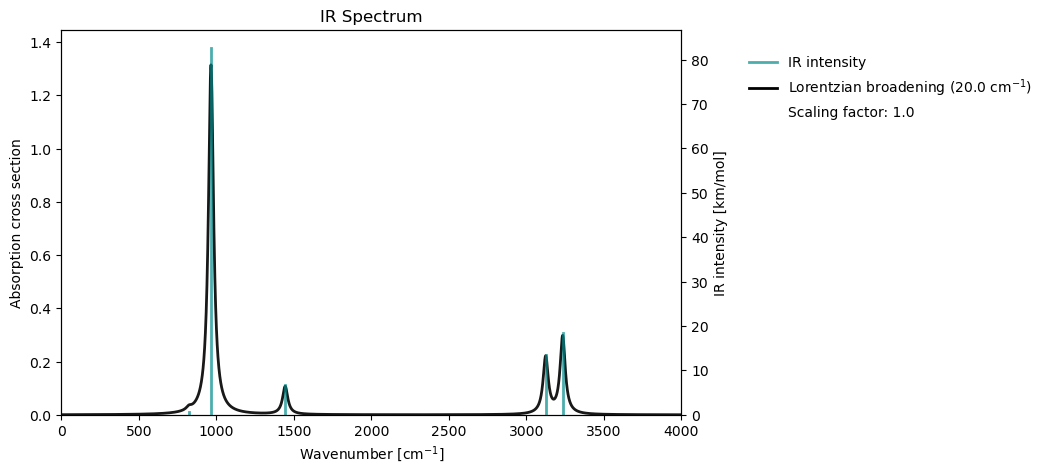
<Figure size 800x500 with 2 Axes>
References
  1. Wang, L.-P., & Song, C. (2016). Geometry optimization made simple with translation and rotation coordinates. J. Chem. Phys., 144, 214108. 10.1063/1.4952956
  2. Wilson, E. B., Decius, J. C., & Cross, P. C. (1980). Molecular Vibrations. Dover, New York.
  3. Eckart, C. (1935). Some Studies Concerning Rotating Axes and Polyatomic Molecules. Phys. Rev., 47, 552–558. 10.1103/PhysRev.47.552