Many-electron wave functions
Hilbert space of state vectors ¶ State vectors for a system with N N N
V = V 1 ⊗ V 2 ⊗ ⋯ ⊗ V N \mathcal{V} =
\mathcal{V}^1 \otimes \mathcal{V}^2 \otimes \cdots \otimes \mathcal{V}^N V = V 1 ⊗ V 2 ⊗ ⋯ ⊗ V N where the separate particle spaces are described under the section discussing orbitals .
Pauli principle ¶ Electrons are fermions and obey the Pauli principle so V \mathcal{V} V
∣ Ψ ⟩ = 1 N ! ∑ P 1 , 2 , … , N [ ∣ ψ 1 ⟩ ⊗ ∣ ψ 2 ⟩ ⊗ ⋯ ⊗ ∣ ψ N ⟩ ] | \Psi \rangle =
\frac{1}{\sqrt{N!}}
\sum \mathcal{P}_{1,2,\ldots,N}
\Big[
| \psi_{1} \rangle \otimes | \psi_{2} \rangle \otimes \cdots \otimes | \psi_{N} \rangle
\Big] ∣Ψ ⟩ = N ! 1 ∑ P 1 , 2 , … , N [ ∣ ψ 1 ⟩ ⊗ ∣ ψ 2 ⟩ ⊗ ⋯ ⊗ ∣ ψ N ⟩ ] where the sum includes all N ! N! N ! N N N ∣ ψ i ⟩ | \psi_{i} \rangle ∣ ψ i ⟩ N N N
Slater determinants ¶ Expressed in coordinate space, the anti-symmetrized state vectors are known as Slater determinants
∣ Φ ⟩ = ∣ ψ 1 , … , ψ N ⟩ ↔ 1 N ! ∣ ψ 1 ( r 1 ) ⋯ ψ N ( r 1 ) ⋮ ⋱ ⋮ ψ 1 ( r N ) ⋯ ψ N ( r N ) ∣ | \Phi \rangle =
|\psi_{1}, \ldots, \psi_{N} \rangle \leftrightarrow
\frac{1}{\sqrt{N!}}
\begin{vmatrix}
\psi_{1}(\mathbf{r}_1) & \cdots & \psi_{N}(\mathbf{r}_1) \\
\vdots & \ddots & \vdots \\
\psi_{1}(\mathbf{r}_N) & \cdots & \psi_{N}(\mathbf{r}_N) \\
\end{vmatrix} ∣Φ ⟩ = ∣ ψ 1 , … , ψ N ⟩ ↔ N ! 1 ∣ ∣ ψ 1 ( r 1 ) ⋮ ψ 1 ( r N ) ⋯ ⋱ ⋯ ψ N ( r 1 ) ⋮ ψ N ( r N ) ∣ ∣ With a set of spin orbitals that spans the one-electron space V 1 \mathcal{V}^1 V 1 N N N V \mathcal{V} V
Unitary orbital transformations ¶ Let A \mathbf{A} A
A = ( ψ 1 ( r 1 ) ⋯ ψ N ( r 1 ) ⋮ ⋱ ⋮ ψ 1 ( r N ) ⋯ ψ N ( r N ) ) \mathbf{A} =
\begin{pmatrix}
\psi_{1}(\mathbf{r}_1) & \cdots & \psi_{N}(\mathbf{r}_1) \\
\vdots & \ddots & \vdots \\
\psi_{1}(\mathbf{r}_N) & \cdots & \psi_{N}(\mathbf{r}_N) \\
\end{pmatrix} A = ⎝ ⎛ ψ 1 ( r 1 ) ⋮ ψ 1 ( r N ) ⋯ ⋱ ⋯ ψ N ( r 1 ) ⋮ ψ N ( r N ) ⎠ ⎞ such that the Slater determinant is equal to
Φ ( r 1 , … , r N ) = 1 N ! d e t ( A ) \Phi(\mathbf{r}_1, \ldots, \mathbf{r}_N) =
\frac{1}{\sqrt{N!}} \mathrm{det}\big(\mathbf{A}\big) Φ ( r 1 , … , r N ) = N ! 1 det ( A ) Let matrix B B B A A A
B = A U \mathbf{B} = \mathbf{A U} B = AU For determinants, we have
d e t ( B ) = d e t ( A U ) = d e t ( A ) d e t ( U ) = d e t ( A ) e i ϕ \mathrm{det}\big(\mathbf{B}\big) =
\mathrm{det}\big(\mathbf{A U}\big) = \mathrm{det}\big(\mathbf{A}\big) \mathrm{det}\big(\mathbf{U}\big) =
\mathrm{det}\big(\mathbf{A}\big) e^{i\phi} det ( B ) = det ( AU ) = det ( A ) det ( U ) = det ( A ) e i ϕ This shows that a unitary transformation of occupied orbitals in a Slater determinant does not change the many-electron wave function with more than a trivial overall phase factor.
Normalization ¶ A general multi-electron wave function is expanded in the basis of Slater determinants
∣ Ψ ⟩ = ∑ i c i ∣ Φ i ⟩ | \Psi \rangle = \sum_i c_i | \Phi_i \rangle ∣Ψ ⟩ = i ∑ c i ∣ Φ i ⟩ and it is normalized according to
⟨ Ψ ∣ Ψ ⟩ = ∫ ⋯ ∫ Ψ † ( r 1 , … , r N ) Ψ ( r 1 , … , r N ) d 3 r 1 ⋯ d 3 r N = 1 \langle \Psi | \Psi \rangle =
\int \cdots \int
\Psi^\dagger(\mathbf{r}_1, \ldots, \mathbf{r}_N) \Psi(\mathbf{r}_1, \ldots, \mathbf{r}_N) \,
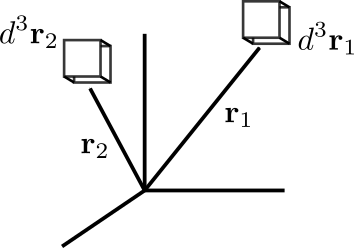
\mathrm{d}^3 \mathbf{r}_1 \cdots \mathrm{d}^3\mathbf{r}_N = 1 ⟨ Ψ∣Ψ ⟩ = ∫ ⋯ ∫ Ψ † ( r 1 , … , r N ) Ψ ( r 1 , … , r N ) d 3 r 1 ⋯ d 3 r N = 1 Probabilistic interpretation ¶ The probability of simultaneously finding electron 1 in the infinitesimal volume element d 3 r 1 \mathrm{d}^3\mathbf{r}_1 d 3 r 1 d 3 r 2 \mathrm{d}^3\mathbf{r}_2 d 3 r 2
∣ Ψ ( r 1 , … , r N ) ∣ 2 d 3 r 1 ⋯ d 3 r N | \Psi(\mathbf{r}_1, \ldots, \mathbf{r}_N) |^2 \mathrm{d}^3 \mathbf{r}_1 \cdots \mathrm{d}^3\mathbf{r}_N ∣Ψ ( r 1 , … , r N ) ∣ 2 d 3 r 1 ⋯ d 3 r N as illustrated below
N N N ¶ The quantity
n ( r 1 , … , r N ) = ∣ Ψ ( r 1 , … , r N ) ∣ 2 n(\mathbf{r}_1, \ldots, \mathbf{r}_N) = | \Psi(\mathbf{r}_1, \ldots, \mathbf{r}_N) |^2 n ( r 1 , … , r N ) = ∣Ψ ( r 1 , … , r N ) ∣ 2 is referred to as the N N N reduced particle densities .